Before Menus. Before Nations.
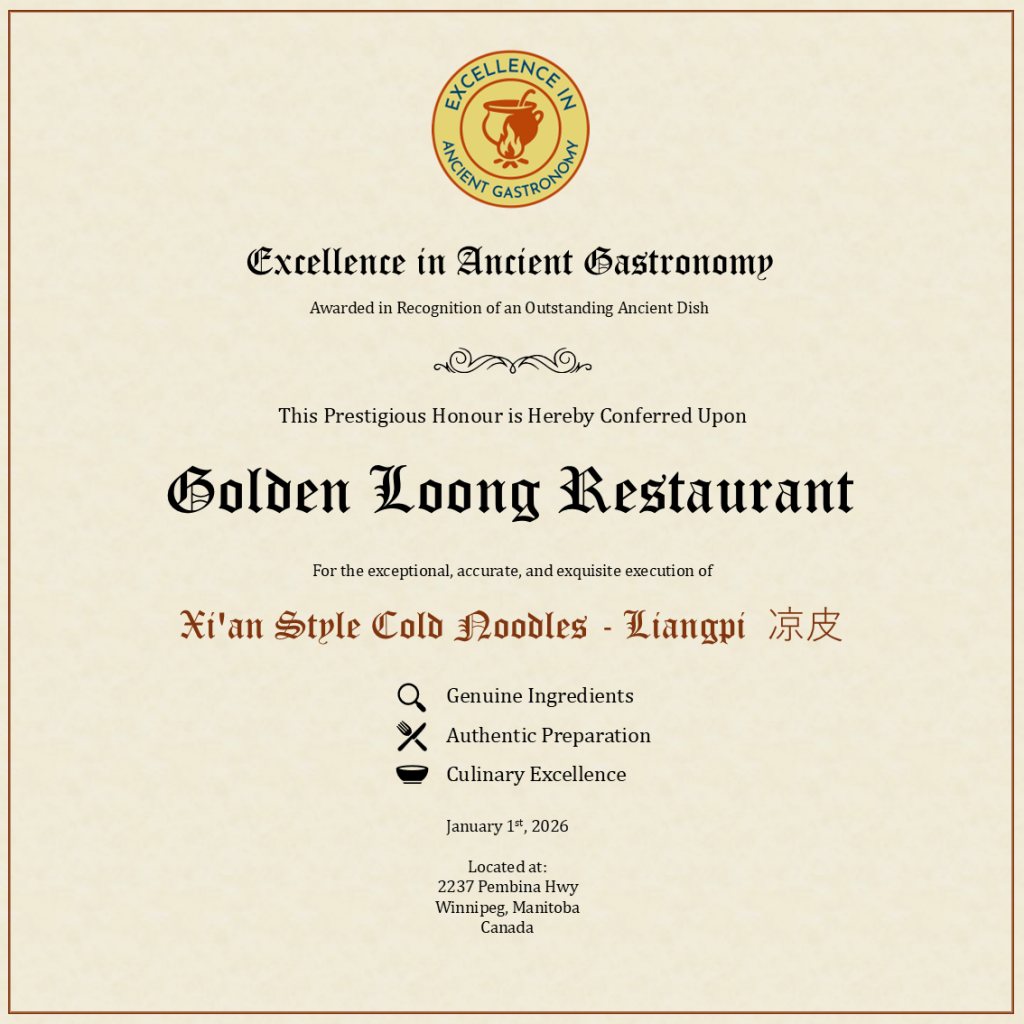
Xi'an Style Cold Noodles - Liangpi (凉皮)
Excellence in Ancient Gastronomy
Awarded in Recognition of Recreating Outstanding Culinary Ancient Cuisine
This Prestigious Honour is Hereby Conferred Upon
Golden Loong Restaurant
For the exceptional, historically accurate, and exquisitely executed recreation of Xi’an Style Cold Noodles
In recognition of their dedication to preserving and presenting the rich heritage of world cuisine, demonstrating:
Meticulous Research: The accurate sourcing and interpretation of historical culinary texts and ingredients.
Authentic Preparation: The mastery of techniques required to bring this ancient dish back to life.
Culinary Excellence: The commitment to ensuring the revived dish is not only authentic but truly delicious.
"The true legacy of a people is often found on their plate. With this dish, Golden Loong has allowed us to taste history."
Xi’an–style cold noodles, commonly known as liangpi (凉皮), are classified as an ancient dish because they are rooted in early Chinese agricultural practices and food technologies that date back more than two thousand years. Originating in the region of Chang’an—modern-day Xi’an, one of China’s earliest imperial capitals—the dish reflects the everyday cuisine of populations living during the Qin and Han dynasties. Its continued preparation in the same geographic area establishes a rare and direct link between ancient foodways and contemporary regional cooking.
At the core of liangpi is an ancient method of grain processing: washing wheat dough in water to separate starch from gluten. This technique, believed to have emerged during the Qin–Han period (3rd century BCE to 2nd century CE), predates refined milling technologies and demonstrates early empirical knowledge of starch extraction. The resulting starch slurry is steamed into thin sheets and sliced into noodles, a process that has remained fundamentally unchanged for centuries.
The ingredients used in Xi’an–style cold noodles further support their ancient classification. Wheat became a dominant staple in northern China by the Zhou dynasty, while grain vinegars, garlic, and fermented condiments were already well established in ancient Chinese diets. Although modern versions often include chili oil—a post-16th-century addition—the foundational structure of the dish existed long before the arrival of New World ingredients. These later additions enhance flavor without altering the dish’s original identity.
Preparation methods for liangpi rely on low-technology, manual techniques consistent with ancient domestic cooking. Hand kneading, starch washing, steaming, cooling, and hand-cutting reflect pre-modern culinary practices that required no mechanization. Serving the noodles cold also aligns with practical ancient strategies for food consumption in hot climates, particularly in the Wei River valley where Xi’an is located.
Cultural continuity plays a crucial role in defining Xi’an–style cold noodles as an ancient dish. Unlike foods reconstructed from historical texts, liangpi has been consumed continuously by local populations for generations. Its popularity as an affordable street food among laborers, merchants, and travelers—especially along early Silk Road routes—highlights its role in ancient urban food culture and regional identity.
By the Tang dynasty (7th–10th centuries), when Xi’an (then Chang’an) was the world’s largest cosmopolitan city, cold noodle dishes had become popular street foods, appreciated for being inexpensive, filling, and refreshing during the region’s hot summers. Street vendors refined the seasoning toward the characteristic Shaanxi profile: black vinegar, garlic, chili oil, and sesame. This flavor combination became deeply associated with the region’s cuisine, known for its bold, sour-spicy balance.
Liangpi as we recognize it today — soft, ribbon-like noodles made from wheat or rice starch, served chilled with a bright, fiery sauce — took shape during the Ming and Qing dynasties, when specialized liangpi shops and noodle makers spread throughout Shaanxi. By the 20th century, it had become one of the defining foods of Xi’an, ranked alongside dishes like roujiamo and biangbiang noodles.
Golden Loong Restaurant
2237 Pembina Hwy, Winnipeg, MB R3T 2H1
(204) 504-6766
www.goldenloongrestaurant.com/
Awarded March 3rd, 2026